
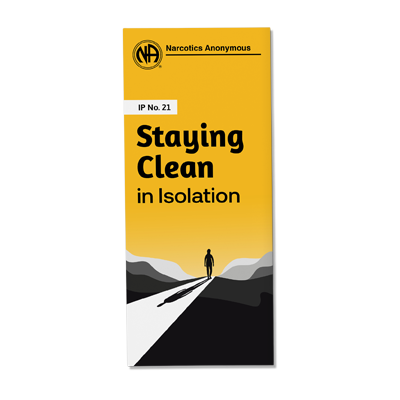
Staying Clean in Isolation
Introduction
Every time I feel like I am all alone, I remember that there are others in the Fellowship who also feel alone, possibly in the same exact moment.
Narcotics Anonymous is a program of connection—some people even say NA stands for “never alone.” Most of us, at some point in our recovery, have experienced deep loneliness and isolation. Even when we are emotionally, physically, or geographically alone, we can stay clean and find a new way to live.
There are many reasons we may be isolated: We may live far from any NA meetings or lack transportation to get there. Our physical health can limit us. We may be caring for children or others who cannot be left alone. We may be working long hours or on the road; we may be displaced, or in a job or living situation we cannot easily leave. Yet if the NA message has found us, we can find our way to the message.
Our recovery in NA includes both connection to others and connection to a Power greater than ourselves. At different times in our recovery we build bridges from isolation to connection in different ways. Our Basic Text reminds us that “there is no model of the recovering addict,” and our experience has shown that we can stay clean and recover from the disease of addiction “no matter what.”
More than ever before, we have resources to stay in touch, participate, work Steps, and be of service, regardless of physical, geographical, or other limitations. Some of us have experienced total isolation where no communication with others was possible. The program of Narcotics Anonymous gave us tools to get through those times, too. Being honest about our circumstances, open-minded about what can work for us, and willing to try new ways of thinking about our program allows us to experience our isolation as an opportunity rather than an obstacle.
Addiction and Isolation
Addiction is a disease that thrives in isolation. We experience isolation when we are distanced from NA members, even when we have been part of an NA community for a long time. Isolation can manifest physically, emotionally, or spiritually.
For the member who finds NA online or in print and cannot attend meetings in person, virtual meetings and long-distance sponsorship may feel “normal.” But for an addict who becomes isolated after having long been part of an in-person NA community, the same experience may feel profoundly alienating.
Some of us may live far from in-person meetings, and we may be in a position to bring NA into our local community by starting meetings; others of us cannot attend meetings in person for other reasons, even if they’re nearby. Regardless of our specific circumstance, we all need to stay clean no matter what. NA is here for us when we are struggling. Seeking NA through virtual meetings or social media, calling people we’ve met at meetings or events, even writing letters allows us to connect with other members who believe in us and want to help us in our recovery. We build our “we” and help others feel included by making a phone call, sharing a link or a piece of literature, or offering a ride. Even a small gesture that helps someone feel seen and recognized— remembering someone’s name, or inviting them to fellowship after the meeting—can make all the difference.
“In the stillness I came to know that I’m part of the world. I’m part of something bigger than me.”
There are times when we can’t reach another addict in recovery. One member spent their first winter clean in a remote wilderness. She shared, “In the stillness I came to know that I’m part of the world. I’m part of something bigger than me. At night, in pain, I would think, There are others out there feeling what I’m feeling and staying clean. In the day I could watch the trees and know I’m alive just like they are. It’s a clarity that hasn’t left me.”
We all have tools we can use if we want to stay clean. NA literature is available to us online or by mail. We may reach out by phone or online, find our way to a virtual meeting, or share with an individual member. NA members are here to help us. For many of us, staying clean in isolation deepens a relationship with a Power greater than ourselves. A time of isolation provides an opportunity to dive deep into stepwork with a sponsor and into the study of our guiding principles. Inventory work might help us understand our isolation differently and find some new solutions or deeper acceptance. That’s not to say it’s easy.
Crisis
Some NA members find themselves isolated when caring for a sick or disabled loved one. The combination of being isolated, in a state of “high alert,” and feeling like the only one going through something so difficult can be deeply challenging. “My husband was in intensive care, and I was at a hospital in a strange town where I didn’t know anyone,” a member shared. “In that time, I noticed I could pay attention to the miracles all around us. Every breath is a miracle. When someone is really sick it’s easier to see that.”
There are times when we need NA desperately, and it’s just not possible to get to a meeting. Whether we make contact online or by phone, whether we reach out or isolate, whether we build a new NA community around us or a new safe place within ourselves—the program is still with us, because it lives in us.
Relapse or destructive action in a time of hardship can wake up our disease and create more problems, distracting us and those around us from the crisis at hand. In contrast, when we stay clean, we can show up with grace and fortitude we may not even know we possess. Our Basic Text reminds us, “No matter how painful life’s tragedies can be for us, one thing is clear, we must not use, no matter what!” Our experience has shown that if we put forth even half the effort to stay clean that we did to use, we have an excellent chance of maintaining our recovery. We may find a deeper relationship with a Power greater than ourselves, a strength we didn’t know we had, a kind of courage that perhaps we admired in others but never imagined for ourselves. When we reach out for help, we begin to grow.
“Recovery in NA is a process that transforms our experience into tools for helping others”
Our Basic Text reminds us that “we are not responsible for our disease, but we are responsible for our recovery.” Even when we are isolated, we can find ways and means to connect: in person, virtually, or through prayer and meditation. A variety of resources are available in addition to virtual meetings: Recovery literature is available online; there are audio recordings of the Basic Text in a variety of languages; many local websites have recordings of speakers at meetings or conventions. These can be indispensable tools for learning and growing wherever we are. Local or zonal websites often have links to virtual events, recordings, and more.
Recovery in NA is a process that transforms our experience into tools for helping others. Sometimes it’s as simple as being able to share with another member, “I’ve been through that, and I stayed clean.” And sometimes surviving a hard time clean gives us access to a whole new depth of empathy and understanding. Over time, the same conditions that create our isolation can become a factor in our experience of unity.
Reaching Out For Help
How many times have we heard people say things like “An addict alone is in bad company,” or “NA means Never Alone, Never Again”? When we are isolated we may reflect bitterly on these statements, without considering the ways we might find that sense of belonging we need so desperately. Many members who experienced isolation due to illness or aging shared feelings of frustration. “My big beautiful life in recovery was ripped out from under me and nothing prepared me for it,” said one member. “I needed people to reach out to me to let me know I was still important to my NA community,” shared another. We may want to believe people know how we feel or what we need, but in fact we need to tell them. Reaching out can be especially difficult when we are in pain. A member shared, “Drowning people make no sound. Offering a hand can be the most important thing we do.”
“We may want to believe people know how we feel or what we need, but in fact we need to tell them.”
Some of us are isolated from the technologies that might make reaching out easier. When we are incarcerated, or in places that are very remote or without electricity, we find different ways to connect. Even for those of us who are comfortable with new technologies, old-fashioned letter writing and phone calls can be indispensable tools. The publication Reaching Out is available by mail or on tablets to many addicts who are incarcerated. You can always write or email the NA World Service Office at the address listed among the resources at the end of this pamphlet. The personal stories in the Basic Text, the White Booklet, and the White Booklet Anniversary Edition allow us to learn from members’ experience. Some local NA communities have outreach committees dedicated to helping members in isolated areas or who are homebound. If we anticipate a period of isolation, we can prepare by gathering resources to carry us through. Many Hospitals & Institutions committees provide links between incarcerated members and someone outside who can provide guidance and support through the Steps.
Starting an NA Meeting
Recovering in isolation can motivate us to start meetings. We may feel unprepared or unqualified, but all we really need is willingness. The Group Booklet, Serving NA in Rural and Isolated Communities, and the webpage on how to start a meeting all off er information and inspiration. You can receive a Group Starter Kit from your local service body or from NA World Services. (Follow the link to “How to Start an NA Meeting” at the end of this IP for more information.)
Members from other NA communities are often willing to come help or support the effort. Even so, it takes patience to sit in a room regularly and wait for people to come. Consistency is key. So is getting the word out! Whether the meeting location is posted on community bulletin boards or on local social media, or you reach out to treatment organizations in your community, the meeting will not grow unless people know where to find it. In the story “A Quiet Satisfaction” in our Basic Text, a member who helped start NA in his community shared about the time spent holding space for the meeting: “It renews my commitment every time I find myself alone in a room—although most meetings, these days, have a minimum of four members (and sometimes even twenty).”
If we are isolated by language, starting a meeting in our language may help carry the message to others in the community. Although it takes patience and commitment, there is no joy quite like seeing NA take off in a community. Our gratitude speaks—and often it says exactly what we need to hear to make it another day.
Virtual NA and the Addict in Isolation
Virtual NA has changed the experience of isolation for many NA members. An older member shared, “I had chronic illness and over 40 years clean. I needed to matter. Being online allowed me to be of service again, to feel connected.” A member in a very rural country shared gratitude that “technology makes connection possible even in very remote areas. Even when the internet doesn’t work so well it’s good enough to reach out and ask for help.” There are many members now whose whole experience with the NA Fellowship is online, including being of service. When we are open-minded about what will work for us, we often find that we have what we need—even when it’s not exactly what we want or expect. Online and telephone meetings have allowed NA to come to many of our members who cannot come to NA in person. Some people note that reaching out is different online, though: Conversation before and after the meeting isn’t quite the same, and we might have to ask people to “hang out” virtually or be open to a phone call before we feel quite ready. Reaching out is always an act of courage, and feeling like we are “a part of” takes effort even in person. When we are willing to take a risk and ask for help, we help the person we are asking as much as ourselves.
“The heart of NA beats when two addicts share their recovery.”
Virtual NA allows us to find meetings anytime we like—and it also extends our reach in finding people with whom we can identify. When we feel isolated or apart from meetings even though they may be physically accessible, virtual meetings can provide a sanctuary and a fresh perspective. Some of us readily find community, sponsorship, opportunities to be of service, and a sense of belonging online. For others, feeling at home or even paying attention in online meetings can be a challenge. Just as at in-person meetings, don’t leave five minutes before the miracle! It can take effort to adapt to new circumstances and technologies, but our lives depend on our willingness.
“When we are open-minded about what will work for us, we often find that we have what we need—even when it’s not exactly what we want or expect.”
The Value of Sharing
Narcotics Anonymous is a program of Twelve Steps and Twelve Traditions designed to help addicts find recovery, regardless of where they may be. By practicing these spiritual principles, we can achieve freedom from active addiction whether or not we are in contact with others. But our Basic Text tells us that “the heart of NA beats when two addicts share their recovery.” So we get creative and find ways to share with another addict in person, by mail, by phone, or online.
For some of us, isolation is not about geography or illness. Some of us have a hard time being around people at all; sometimes struggles with mental health or other issues can make the experience of in-person meetings too stressful. Some members share that a bad breakup or other relationship difficulties in the rooms make it hard to keep coming back, even when they desperately want what NA has to off er. Our identity or our opinions may isolate us from our community—either in reality or in our minds. One way or another a rupture happens and, as a member shared, “I suddenly found myself on an island.” One member caught in a violent relationship shared that while going to meetings in person was out of the question, virtual meetings provided a lifeline. “I can get to meetings when I’m at work, or when I’m alone in the house. I have a sponsor online and we’re working on a plan to get free.”
Language and culture issues often intersect, and it’s possible that even when we can understand some of the words, we can feel unwelcome or afraid to share when a meeting is in a language other than our own. Finding a way to share and participate diminishes the feeling of isolation and may even off er a new experience of unity. We may discover that NA is bigger than we thought, and that our experience is not unique—even when we feel very alone.
Living the Program
For some people, being isolated means learning deeper lessons about anonymity: “In the military, my calls and emails were all monitored. They couldn’t know about my NA membership, and my NA people couldn’t know where I was or what I was doing. Hearing a familiar voice sometimes had to be enough; I’d hold on till I was on leave and I could get to a meeting. I didn’t know if I could stay clean that way, but I learned I could. Sometimes I’d be holding on for that next meeting, but I knew it would come.” Perseverance and faith grow with practice. We come to see that NA lives inside us. It’s not a product we consume or even a place we go, although our home group may be central to our experience of connection. As we practice the program we create it, experience it, and see it transform our lives even when we cannot speak it out loud.
Other members have found that being geographically isolated from an NA community created an opportunity to be more vocal and visible about their experience. Being an example to people who have never encountered recovery before can be a powerful way we carry the message. “I learned that I could bring my recovery to wherever I was,” a member shared. “I could be of service wherever I was. I try to remember that I could be the only Basic Text someone will see.” Almost everyone knows somebody who has struggled with addiction, and so many people in the world have lost someone to our disease. Sadly, not enough people know that recovery is possible. When we live the program of Narcotics Anonymous, just being ourselves can carry a powerful message.
“Staying clean in isolation is not a contradiction. It affirms what I’ve lived: that clarity can be forged in silence, that counsel can be found in the digital glow of a night meeting, and that the will to live can return.”
“NA taught me how to connect. Being isolated taught me I can identify with people beyond NA. Sharing from the heart, meeting the people around us where they are, looking for the places I could be of service: These skills translate into the larger world, and I can get the benefits even when I’m not around my Fellowship.” Another member shared, “Staying clean in isolation is not a contradiction. It affirms what I’ve lived: that clarity can be forged in silence, that counsel can be found in the digital glow of a night meeting, and that the will to live can return.”
Our Basic Text tells us that “NA is like a lifeboat in a sea of isolation, hopelessness and destructive chaos.” Because isolation and alienation are so much a part of active addiction, feeling isolated when we are in recovery can be painfully familiar. Yet the experience can be very different—and that difference has the potential to be transformative. Our relationship to ourselves, our Higher Power, and the world around us has changed. There are people who believe in us and want to help us in our recovery. We have spiritual principles to guide us as we navigate through the storms life sometimes brings. The storms don’t define our experience, but how we weather them does. We can stay clean in isolation—and find in our experience a new or renewed strength in our spirituality and our commitment to recovery. Just for today, we have nothing to fear.
“When we live the program of Narcotics Anonymous, just being ourselves can carry a powerful message.”
Resources
There are many resources at our website, na.org.
Find NA literature to read or listen to online or to purchase at:
Find meetings and resources to start meetings at:
- na.org/meetingsearch
- na.org/virtualmeetings
- na.org/how-to-start-a-meeting
- na.org/virtual
- na.org/rural offers guidance and tools for those serving in rural and isolated communities.
For information about goings-on in Narcotics Anonymous as a whole, or to get involved in service, check:
- na.org/subscribe
- na.org/nawsnews
- social media:
- Facebook: @naworldservices
- Instagram: @narcoticsanonymous
Of, by, and for incarcerated NA members, the quarterly publication Reaching Out is available here:
Mailing address:
NA World Service Office
PO Box 9999
Van Nuys, CA 91409 USA
Copyright © 1986, 1998, 2026 by
Narcotics Anonymous World Services, Inc.
All rights reserved
World Service Office
PO Box 9999
Van Nuys, CA 91409 USA
T +1/818.773.9999
F +1/818.700.0700
Website: www.na.org
World Service Office–CANADA
Mississauga, Ontario
World Service Office–EUROPE
Brussels, Belgium
Tel. +32/2/646-6012
World Service Office–IRAN
Tehran, Iran
www.wsoiran.org
This is NA Fellowship-approved literature.
Narcotics Anonymous,  and The NA Way
are registered trademarks of
Narcotics Anonymous World Services, Incorporated.
ISBN 978-0-912075-31-0 English 6/26
WSO Catalog Item No. 3121